
How to Optimize Your Garment Factory Layout for Maximum Efficiency
In the fast-paced apparel manufacturing industry, profit margins are won or lost on the shop floor. If your operators are constantly waiting for materials, walking long distances to drop off bundles, or adjusting their posture due to poorly designed setups, your factory is losing money.
Optimizing your garment factory layout isn’t just about packing more machinery into a room—it’s about creating an uninterrupted, fluid movement of goods from raw fabric rolls to final packed cartons.
Here is a step-by-step guide to designing a high-efficiency layout using lean manufacturing principles and the right shop floor infrastructure.
1. Map Out a Straight-Line or U-Shaped Material Flow
The primary enemy of factory efficiency is “backtracking”—when materials move backward in the production sequence. This creates confusion, clutter, and severe bottlenecks.
Most world-class garment facilities utilize one of two layout patterns to keep movement moving forward:
The Straight-Line Flow: Ideal for long, narrow facilities where raw materials enter at one end and finished products exit at the exact opposite end.
The U-Shaped Flow: Excellent for square spaces or facilities where the receiving and shipping bays are located near each other. Materials move down one side of the “U” through cutting and sewing, and loop back through finishing and packaging.
By ensuring your Fabric Storage Racks feed directly into the cutting zone without crossing paths with finished goods, you eliminate unnecessary handling and drastically cut down on material transit times.
2. Implement Modular Line Production Tables
The sewing section is the heart of your garment factory, but styles change frequently. A rigid, unalterable floor plan will stall your operations the moment you transition from producing basic t-shirts to complex jackets.
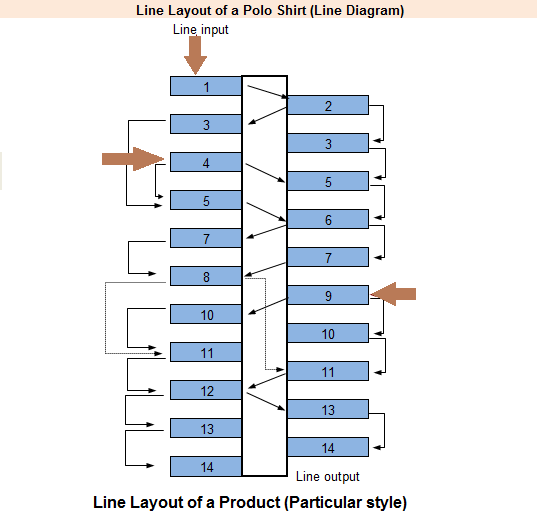
Using modular, heavy-duty Line Production Tables allows you to configure your workspace dynamically based on your product styling. Ensure your central center tables feature a smooth, seamless surface—such as high-quality Pre-Laminated Particle Board (PLPB)—to prevent delicate fabrics from snagging as they travel down the assembly line.
3. Position Quality Control Directly Within the Flow
Waiting until the very end of the production cycle to catch mistakes is an expensive error. Defective stitching discovered at final packaging requires time-consuming unstitching and massive rework.
Integrate designated quality checkpoints directly inside your production line layout:
Fabric Inspection Station: Place a dedicated Fabric Inspection Table at the very beginning of the layout, right after fabric rolling. Catching shade variations, skewness, or knitting defects before cutting saves countless hours of wasted labor downstream.
Mid-Line Checking: Place compact Fabric Checking & Finishing Tables at critical hand-off points in the sewing line to spot errors instantly when they happen.
4. Keep the Floor Clear with Dedicated Industrial Trolleys
A major hidden drain on factory efficiency is floor clutter. Bundles of cut fabric piled up around sewing machines block operators, slow down transit, and risk getting soiled or stained.
Instead of stacking materials on the floor, implement a mobile transit strategy:
Use specialized Industrial Trolleys (such as bin or cage trolleys) to move cut bundles seamlessly from the cutting department to individual sewing stations.
Keep transport aisles clearly painted and completely free of stationary items so material handlers can move quickly without obstruction.
5. Prioritize Ergonomics to Prevent Operator Fatigue
Efficiency drops sharply during the afternoon shift if your operators are working in physical discomfort. Slouching, repetitive strain, and inadequate workspace lighting slow down sewing speeds and increase error rates.
To keep efficiency high across an 8-hour shift, invest in proper infrastructure:
Industrial Chairs & Stools: Standard plastic chairs or wooden benches don’t cut it. Operators require heavy-duty, ergonomically designed industrial seating that offers proper lumbar support and is adjustable to the height of the needle bed.
Ergonomic Workstations: Ensure that checking tables and inspection platforms are at optimal heights to reduce continuous bending.
Conclusion: Small Layout Changes, Big ROI
Maximizing your garment factory’s efficiency doesn’t necessarily require investing in expensive automated robotics. Often, the highest return on investment comes from simply rearranging your floor layout, removing transit friction, and providing your workforce with heavy-duty, purpose-built furniture.
From organizing your raw goods on sturdy storage racks to keeping production moving smoothly down modular line tables, every centimeter saved translates directly into lower manufacturing costs.
Ready to Upgrade Your Factory Floor Layout?
At National Fabricators, we design and manufacture heavy-duty, industrial-grade furniture built specifically for high-efficiency garment manufacturing lines. Explore our full range of customizable Line Production Tables, Fabric Inspection Tables, Industrial Trolleys, and Ergonomic Seating to build a world-class factory floor.